Saturday, 28 January 2017

Transistor

A transistor is a semiconductor device used to amplify or switch electronic signals and electrical power. It is composed of semiconductor material usually with at least three terminals for connection to an external circuit. A voltage or current applied to one pair of the transistor’s terminals controls the current through another pair of terminals. Because the controlled (output) power can be higher than the controlling (input) power, a transistor can amplify a signal.

How it works

A transistor is really simple and really complex. Let’s start with the simple part. A transistor is a miniature electronic component that can do two different jobs. It can work either as an amplifier or a switch:


  • When it works as an amplifier, it takes in a tiny electric current at one end (an input current) and produces a much bigger electric current (an output current) at the other. In other words, it's a kind of current booster. That comes in really useful in things like hearing aids, one of the first things people used transistors for. A hearing aid has a tiny microphone in it that picks up sounds from the world around you and turns them into fluctuating electric currents. These are fed into a transistor that boosts them and powers a tiny loudspeaker, so you hear a much louder version of the sounds around you. William Shockley, one of the inventors of the transistor, once explained transistor-amplifiers to a student in a more humorous way: "If you take a bale of hay and tie it to the tail of a mule and then strike a match and set the bale of hay on fire, and if you then compare the energy expended shortly thereafter by the mule with the energy expended by yourself in the striking of the match, you will understand the concept of amplification."
  • Transistors can also work as switches. A tiny electric current flowing through one part of a transistor can make a much bigger current flow through another part of it. In other words, the small current switches on the larger one. This is essentially how all computer chips work. For example, a memory chip contains hundreds of millions or even billions of transistors, each of which can be switched on or off individually. Since each transistor can be in two distinct states, it can store two different numbers, zero and one. With billions of transistors, a chip can store billions of zeros and ones, and almost as many ordinary numbers and letters (or characters, as we call them). More about this in a moment.

Wednesday, 5 March 2014

PLC (Programmable Logic Controller)

A programmable logic controller is a digital computer used for automation of electromechanical processes, such as control of machinery on factory assembly lines, amusement rides, or light fixtures. PLCs are used in many industries and machines. Unlike general-purpose computers, the PLC is designed for multiple inputs and output arrangements, extended temperature ranges, immunity to electrical noise, and resistance to vibration and impact. Programs to control machine operation are typically stored in battery-backed-up or non-volatile memory. A PLC is an example of a hard real time system since output results must be produced in response to input conditions within a limited time, otherwise unintended operation will result.


Programmable logic controllers provide dependable, high speed control and monitoring demanded
by a wide variety of automated applications. Before the automotive industry discovered the advantages of PLC’s, the process of modifying relay circuitry was a headache inducing endeavor. In the past, annual car model changes forced plant engineers to constantly modify production equipment managed by relay circuitry. In some cases, the engineers had to scrap entire relay controlled panels and replace them with completely redesigned systems. Now, PLC’s allow engineers to implement numerous manufacturing changes with relative ease, which reduces changeover costs and downtime.  Prior to PLC’s, cont-actor or relay controls solved many of these control tasks. This is often referred to as hardwired control. Electricians had to design circuit diagrams, specify and install electrical components, and create wiring lists before wiring the components necessary to perform a specific task. Design errors would force the electrician to trace the wires to identify the problem and then reconnect the wires. A change in function or a system expansion required extensive component changes and rewiring. Now, PLC software programming makes wiring changes between devices and relay contacts easier. Although hard wiring is still necessary for connecting field devices, it’s less intensive than before.


Sunday, 30 June 2013

Door Open Sensor


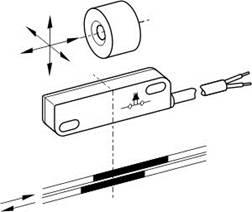
Each Door Open Sensor is made up of two parts. A magnet and a switch. The magnet will be attached to the door. The switch will be attached to the door frame.

Depending on the relative position of magnet and switch, the switch will open or close. With the proper placement, this will allow the detection of the door being opened or closed

Once the switch is wired to an input of the Frotcom GPS/GPRS device; these changes will be detected and communicated to the Frotcom Data Center.

Then, Frotcom will update the door open status for that vehicle and check for alarm conditions.
*


Main features
Here are some of the main features of the Door Open Sensor:
  • Thermoplastic enclosure
  • Flat design
  • Long life
  • Non-contacting principle
  • 1 reed contact
  • Actuating distance up to 60mm
  • Actuating surface marked by protrusion
  • Pre-wired cable with length 1m
  • Protection class IP 67


Thursday, 20 June 2013

BURGLAR ALARM


http://bits.wikimedia.org/static-1.20wmf11/skins/common/images/magnify-clip.png
A burglar alarm is a system designed to detect intrusion – unauthorized entry – into a building or area. They are also called security alarms, security systems, alarm systems, intrusion detection systems, perimeter detection systems, and similar terms.

Burglar alarms are used in residential, commercial, industrial, and military properties for protection against burglary (theft) or property damage, as well as personal protection against intruders. Car alarms likewise protect vehicles and their contents. Prisons also use security systems for control of inmates.

Some alarm systems serve a single purpose of burglary protection; combination systems provide both fire and intrusion protection. Intrusion alarm systems may also be combined with closed circuit television surveillance systems to automatically record the activities of intruders, and may interface to access control systems for electrically locked doors. Systems range from small, self-contained noisemakers, to complicated, multi-area systems with computer monitoring and control.


Sunday, 9 June 2013

GAS SENSOR MQ-6


Whenever there is LPG concentration of 1000 ppm (parts per million) in the area, the OUT pin of the sensor module goes high. This signal drives timer IC 555, which is wired as an a stable multivibrator. The multivibrator basically works as a tone generator.

Output pin 3 of IC 555 is connected to LED1 and speaker-driver transistor SL100 through current-limiting resistors R5 and R4, respectively. LED1 glows and the alarm sound to alert the user of gas leakage. The pitch of the tone can be changed by varying preset VR1. Use a suitable heat-sink for transistor SL100.


Gas Sensor MQ-6

 FEATURES

High sensitivity to LPG, ISO-butane, propane
Small sensitivity to alcohol, smoke.
Fast response.
Stable and long life
Simple drive circuit

APPLICATION

They are used in gas leakage detecting equipments in family and industry, are suitable for detecting of LPG, ISO-butane, propane, LNG, avoid the noise of alcohol and cooking fumes and cigarette smoke.


Tuesday, 4 June 2013

TEMPERATURE SENSOR LM35

General description of  LM 35


The LM35 is an integrated circuit sensor that can be used to measure temperature with an electrical output proportional to the temperature (in oC) The LM35 series are precision integrated-circuit temperature sensors, whose output voltage is linearly proportional to the Celsius (Centigrade) temperature. The LM35 thus has an advantage over linear temperature sensors calibrated in ° Kelvin, as the user is not required to subtract a large constant voltage from its output to obtain convenient Centigrade scaling. The LM35 does not require any external calibration or trimming to provide typical accuracies of ±1⁄4°C at room temperature and ±3⁄4°C over a full −55 to +150°C temperature range. Low cost is assured by trimming and calibration at the wafer level. The LM35’s low output impedance, linear output, and precise inherent calibration make interfacing to readout or control circuitry especially easy. It can be used with single power supplies, or with plus and minus.

                                                           
LM 35 Temperature Sensor 
                                                      
Features
1.      Calibrated directly in ° Celsius (Centigrade)
2.      Linear + 10.0 mV/°C scale factor
3.      0.5°C accuracy guarantee able (at +25°C)
4.      Rated for full −55° to +150°C range
5.      Suitable for remote applications
6.      Low cost due to wafer-level trimming
7.      Operates from 4 to 30 volts
8.      Less than 60 μA current drain
9.      Low self-heating, 0.08°C in still air
10.  Non linearity only ±1⁄4°C typical
11.  Low impedance output, 0.1 W for 1 mA load

 Advantages of LM35  to Measure Temperature?
You can measure temperature more accurately than a using a thermistor.  
The sensor circuitry is sealed and not subject to oxidation, etc.
The LM35 generates a higher output voltage than thermocouples and may not require that the output voltage be amplified.

Working of LM35:
The scale factor is .01V/oC. 

The LM35 does not require any external calibration or trimming and maintains an accuracy of +/-0.4 oC at room temperature and +/- 0.8 oC over a range of 0 oC to +100 oC.

Another important characteristic of the LM35DZ is that it draws only 60 micro amps from its supply and possesses a low self-heating capability. 

The sensor self-heating causes less than 0.1 oC temperature rise in still air. 

It has an output voltage that is proportional to the Celsius temperature. 

Sunday, 24 February 2013